

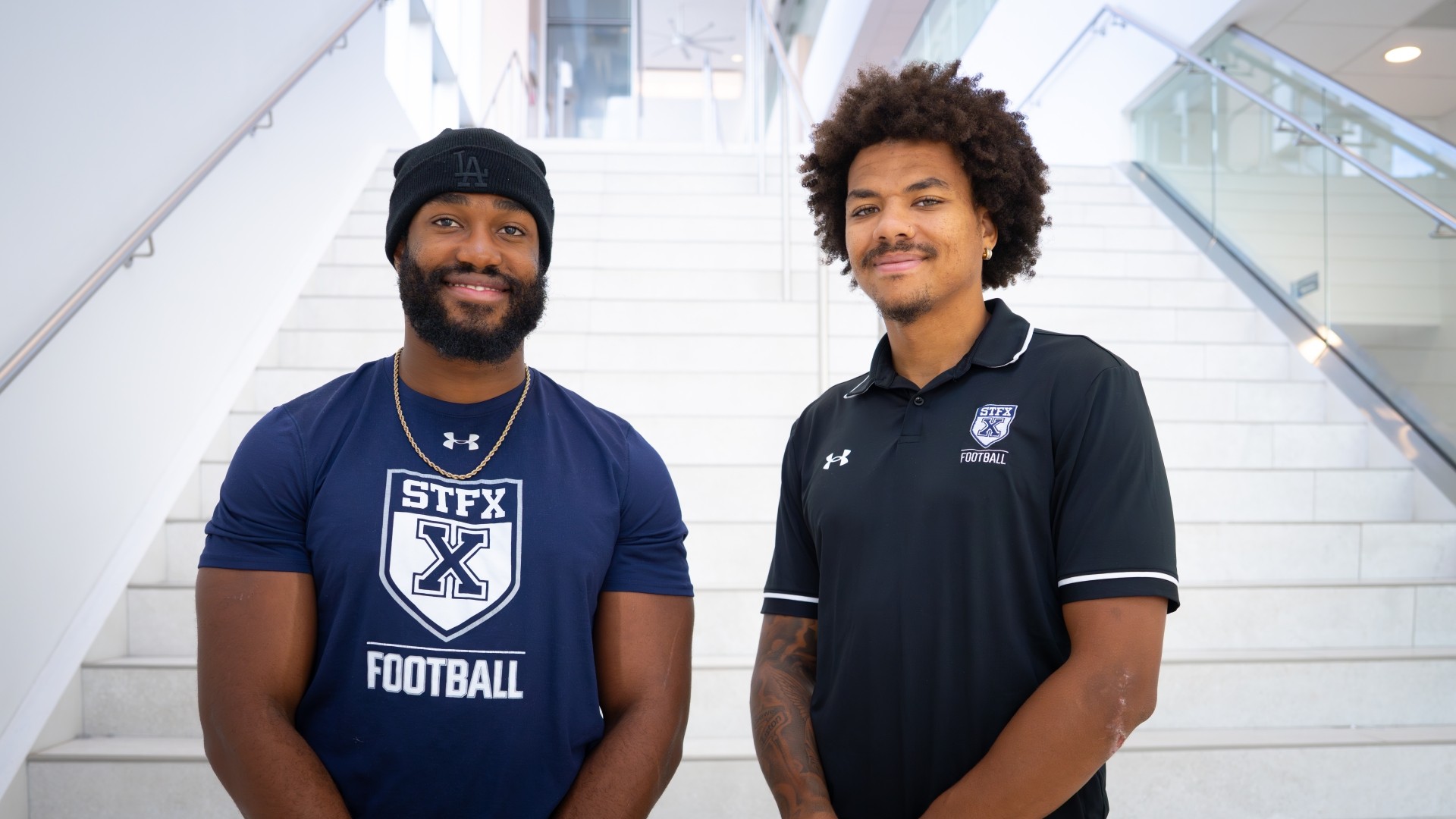
StFX student Devaughn Blackwood of Ottawa, ON received a Social Sciences and Humanities Research Council of Canada (SSHRC) USRA Black Scholar Award for a research project assessing NBA player performance, salary, and team success, looking at whether NBA players are overpaid or underpaid relative to their contribution. Fellow StFX student, Otito Ngaowu of London, ON, is the recipient of a Canadian Institutes of Health Research (CIHR) Black Scholar Award. His research focused on physical activity and informal caregivers, exploring the role of wearable technology in health promotion.
Each award is valued at $9,000 for 14 weeks of research under the supervision of a StFX faculty member.
DEEPEN KNOWLEDGE, OPEN OPPORTUNITY
Mr. Blackwood, who graduated in 2025 with a major in advanced accounting and a minor in sports management and who is continuing his education at StFX, worked with economics professor Dr. Patrick Withey to analyze what factors influence the salary of NBA players in terms of statistics.
“This opportunity meant a lot to me as it is something I had always wanted to look at but never had the resources or knowledge available. It is a testament to Dr. Withey as well as St. Francis Xavier University for providing all the resources to make it happen,” says Mr. Blackwood, a second time SSHRC USRA award recipient. He also received the award in 2023.
“I was able to pursue something I am passionate about, deepen my knowledge and produce results. This opportunity is truly a blessing, and I am so glad as a second time recipient that I was able to get chosen.”
Mr. Blackwood says the research will have a huge impact on his life moving forward. “I’ve always said that a sports economist or sports statistician is something that truly interests me and now I have work that can present my skillset. It is somewhat of a niche market, those who love numbers but also love sports and my ability to combine them will benefit me greatly in the future.”
Mr. Blackwood hopes to present his findings to professionals and that the model can either be improved upon or used when making decisions.
He and Dr. Withey analyzed what factors influence the salary of NBA players in terms of statistics. From there they built a database containing all NBA players over the past five years and their salaries.
Overall, the goal was to build something that could help analyze this for teams and have a regression model to determine the value that a player brings.
“The foundation has been made, but one thing I have learned is there will never be an exact correct conclusion that suits all players. We are currently still working on finding the best regression model to capture most of the data. The work has already begun to be furthered as I have shared the database with other students. I will continue to work on this to try and find my original result, however, Dr. Withey and I hope that other students can continue to pick up off this database.”
Mr. Blackwood says the highlight of this experience was becoming more familiar with economics.
“Before even starting to draw conclusions, I had to learn the intricacies of economics and how one thing affects another. Another highlight was applying learnings from class to the real world and specifically my interests. I love sports and I love numbers and the ability to combine these, and work was outstanding. Lastly the thing that probably stands out most was the ability to learn how to use new software. Specifically, one called Stata IC, which is where I was able to import my database and start running regression models. This application is used by many economists, and I am glad I also now have a good understanding of how to use it.”
WEARABLE MOVEMENT SENSORS AND MENTAL HEALTH
Otito Ngaowu, who graduates with a human kinetics degree in December 2025, is looking at the relationship between caregivers and wearable movement sensors and physical ability to improve mental health outcomes. He’s exploring how wearable movement sensors might help reduce stress and improve physical and mental health among adult caregivers, a group he says often carry physical and emotional challenges.
Supervised by human kinetics professor Dr. Ryan Reid and co-supervised by nursing faculty member Meaghan Ryan, Mr. Ngaowu worked on a survey to evaluate if caregivers who use wearable movement sensors had better mental health outcomes than caregivers who don’t. Previous research suggests these devices can encourage more movement, which is linked to better physical and mental outcomes, and he expects his findings to reflect that trend.
His study focuses on adult caregivers, who may also be supporting aging parents, spouses, or loved ones, while often also working or raising children.
He was drawn to the topic because caregivers often juggle multiple responsibilities and face significant stress. Time is frequently a barrier to physical activity, he explains, but simple reminders to move, such as standing or taking short walks, can positively affect both physical and mental health. Improved stress management and enhanced quality of life are commonly observed benefits.
To recruit participants, he has reached out to Facebook caregiver groups, used word of mouth, and connected through Prof. Ryan’s nursing contacts, though he notes that he has encountered some challenges with participant recruitment and that the survey is still ongoing.
He has enjoyed the research process. “It was really fun,” he says. In research you have to read so much to build a base, and he says he learned a lot by going through that process.
Another meaningful aspect of his experience has been the relationship he developed with his supervisor. “He’s really passionate and interested in the field and cool to be around,” he says.
As a varsity football player, Mr. Ngaowu is keeping an open mind about where his athletic career might take him. But he also is focused on an eventual future in health care. He’s always been a science guy, and as an athlete, who has dealt with injuries, he’s learned about rehab both from a personal perspective as well as in his courses.
University as well really opened his eyes to all the opportunities in health care.
Ultimately, he hopes his student research study will contribute to the growing evidence that wearing movement sensors can help caregivers both with improving their physical and mental health outcomes.